
Independent company. Not a government agency, utility or public program. Independent · not a government agency Serving NY · NJ · CT · SW Florida  |  (888) 000-0000 (888) 000-0000
See my options
How it worksFinancing optionsIncentives by stateSolar costReviewsFAQsSee my options
4.9/5 from 7,075+ reviews for our UK parent, Solar Panel Funding, on Trustpilot4.9/5 · 7,075+ UK reviews

No upfront cost solar, explained without the sales pitch

Nothing to pay at installation, because a finance company owns the system and claims the 30 percent federal credit itself. It is also a 20 to 25 year commitment.

Check what is available at your address Takes about a minute. No credit check to look.

What is your ZIP code?

Your ZIP code tells us which utility serves you, which state incentives apply, and whether an installer covers your area.

Do you own the property?

Solar is installed on the roof, so the owner has to be the one to agree to it.

Roughly what is your average monthly electric bill?

A band is fine. This is the single biggest factor in whether solar is worth doing on your home.

How much shade does your roof get between 9am and 3pm?

Shade during the middle of the day matters far more than shade early or late.

Where is the property?

The installer uses the address to measure your roof from aerial imagery before anyone visits.

Where should the installer reach you?

Someone will call to talk it through and answer questions. There is nothing to sign and no obligation.

By submitting this form you are asking us to pass your details, including your name, address, email and telephone number, to Solar Funding USA and to Momentum Solar (Pro Custom Solar LLC), so that they can contact you about residential solar. This is a sale of personal information under some state privacy laws. See our Privacy Policy and Your Privacy Choices.

Prefer not to be called? Send us your question by email instead — you will still get an answer.

  • Checking your ZIP code against installer coverage
  • Identifying your electric utility
  • Looking up the incentives that apply in your state
  • Putting your details together

We do not cover that ZIP code

Our installer partner covers New Jersey and Connecticut statewide, Long Island plus Queens, Brooklyn, the Bronx and Staten Island in New York, and Southwest Florida. Your ZIP code is not in that footprint, so rather than take your details and waste your time, we are telling you now.

See exactly where we do cover, or read what happened to the federal tax credit before you speak to anyone else about solar.

Solar has to be agreed by whoever owns the roof

We are not able to help renters, and we would rather say so at question two than take your phone number first. If you can speak to your landlord or building owner, they are welcome to come back to us themselves.

In the meantime, if your electric bill is the problem, your utility almost certainly runs an energy assistance or efficiency program that is open to renters. It is worth a call to them.

  • $0 at installation on qualifying agreements
  • Maintenance and monitoring usually included for the whole term
  • Available in New York, New Jersey and Connecticut as a lease or a PPA
  • Florida: leases only, PPAs are not permitted by state law

How it actually works

A finance company pays for the system and owns it. Because it owns it, it can claim the 30 percent Section 48E credit, which a homeowner buying the same system in 2026 cannot. It monetises that credit and prices some of the value into what it charges you. You pay nothing on day one, then a monthly amount for the length of the agreement.

That is the whole mechanism. It is not generosity and it is not a government program. It is a tax credit flowing to the party that can use it, with a share passed through to you in the pricing.

What you are actually signing

  • Term: usually 20 or 25 years. Ask for the number, in writing.
  • Escalator: an annual increase, commonly 1 to 3 percent, or zero on a fixed-rate agreement. Ask which one you are being offered.
  • Total of payments: the sum of every payment across the full term. Ask for this figure in dollars and compare it to the cash price of the same system.
  • Maintenance: normally included, because the finance company owns the equipment and wants it producing. Confirm what is covered and what is not.
  • Transfer on sale: generally possible subject to the buyer qualifying. It adds a step to selling the house.
  • End of term: what happens in year 25. Buyout, renewal, removal. Ask.
What “no upfront cost” means. “No upfront cost” and “$0 down” refer to qualifying solar lease or power purchase agreement (PPA) financing, under which eligible homeowners may have no out-of-pocket cost at the time of installation. Solar panels are not free. Under a lease or PPA a third-party finance company owns the system and the homeowner makes monthly payments, typically over a 20 to 25 year term, often with an annual price escalator. Total payments may exceed the cash price of a comparable system. Eligibility depends on homeownership, credit, roof condition, shading, utility provider, location and other underwriting factors, and is not guaranteed.
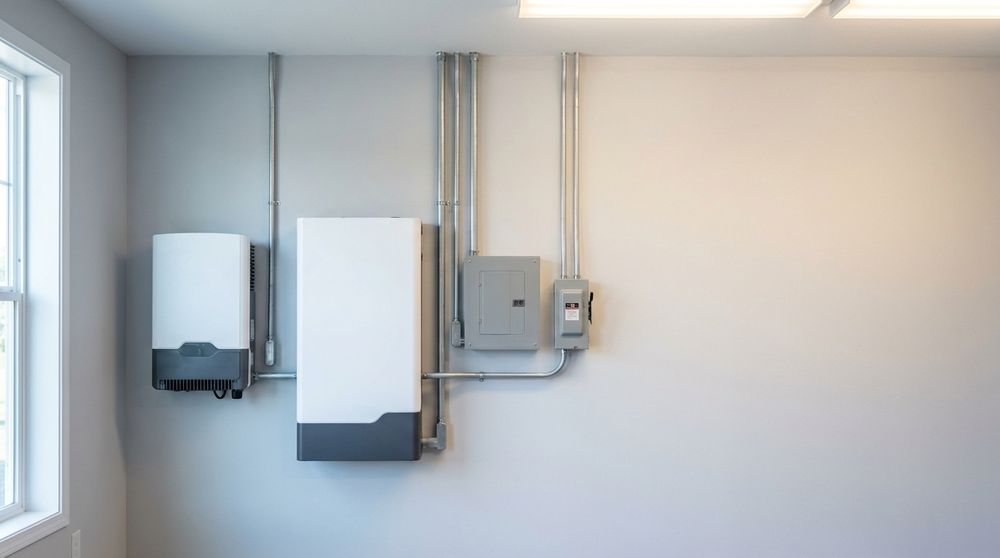
A solar inverter and wall-mounted home battery installed on the clean drywall of an American garage

What actually gets installed

Panels and rails on the roof, an inverter and usually a battery on a garage or utility wall, a small sub-panel and a labelled AC disconnect. Under a lease or PPA all of it belongs to the finance company for the length of the agreement, which is why they carry the maintenance obligation.

Photography on this site is illustrative and does not depict a specific installation by Solar Funding USA or its partners.

The prepaid version

A prepaid lease is the same structure with the payments made upfront as a lump sum. The finance company still owns the system and still claims the 30 percent, which is discounted off what you pay. It suits someone who has the capital but does not have enough tax liability to have used a credit even when one existed. It is growing quickly for exactly that reason.

Where it is worth it and where it is not

It tends to work when

Your bill is high, your roof is south-facing and unshaded, you have limited capital, your tax liability is low, and you plan to stay put. Maintenance being someone else's problem for 25 years has real value.

It tends not to work when

Your bill is under about $100 a month, your roof is heavily shaded, you are likely to move within a few years, or you have capital and a tax position that makes owning obviously better. We will tell you if that is the case rather than push you into an agreement.

Florida. Power purchase agreements are not available to residential customers in Florida. Under Florida Public Service Commission Order 17009, selling electricity to a retail customer makes the seller a public utility. Florida homeowners seeking a no-upfront-cost option are offered a solar lease, not a PPA.

See what is available at my address

FAQs

No upfront cost solar, honestly answered

Is a no upfront cost solar system free?
No, and we will not tell you it is. You pay nothing at installation, then you pay monthly, typically for 20 to 25 years. Total payments over the term may exceed the cash price of a comparable system. What you are buying is the removal of the upfront barrier and, in most agreements, maintenance and monitoring for the life of the term. The Federal Trade Commission has said plainly that offers of free or no-cost solar panels are scams. We agree.
What is the difference between a lease and a PPA?
Under a lease you pay a fixed monthly amount for the equipment regardless of how much it produces. Under a power purchase agreement you pay a set rate per kilowatt-hour for the power it actually produces, so your payment moves with output. A lease is more predictable; a PPA aligns what you pay with what you get. In Florida, only leases are permitted.
What is an escalator?
An annual percentage increase built into your payment, typically between 1 and 3 percent a year. Over 25 years a 2.9 percent escalator roughly doubles the monthly payment from where it started. Fixed-rate agreements with no escalator exist and are becoming more common. Ask which you are being offered and ask for the total of all payments across the full term.
What happens if the finance company goes out of business?
This is a fair question and 2026 is the year to ask it. Sunnova, Solar Mosaic, SunPower, PosiGen and Freedom Forever have all filed for bankruptcy protection since 2024, and over 100 US solar companies have failed or closed since 2023. A 25-year agreement is only as good as whoever is servicing it in year 15. Ask who the finance partner is by name, and ask what happens to the warranty and the maintenance obligation if they are no longer there.
Do I still get the incentives if I do not own the system?
Federally, no: the owner claims Section 48E. At state level it varies and New York is the standout. Under NY Tax Law s606(g-1) a homeowner on a lease, or on a PPA of at least ten years, can claim the state credit of up to $5,000 personally. Connecticut has built assignment of the tariff incentive into the program itself, so it can be split between you and the system owner. New Jersey's SREC-II ownership is set by the agreement, so ask.